Sound familiar?Bridgeport
- The call
- Someone at the front counter always has to unlock the side door by hand before the lunch rush, because the round doorknob out there was never meant to be an exit for a room this size.
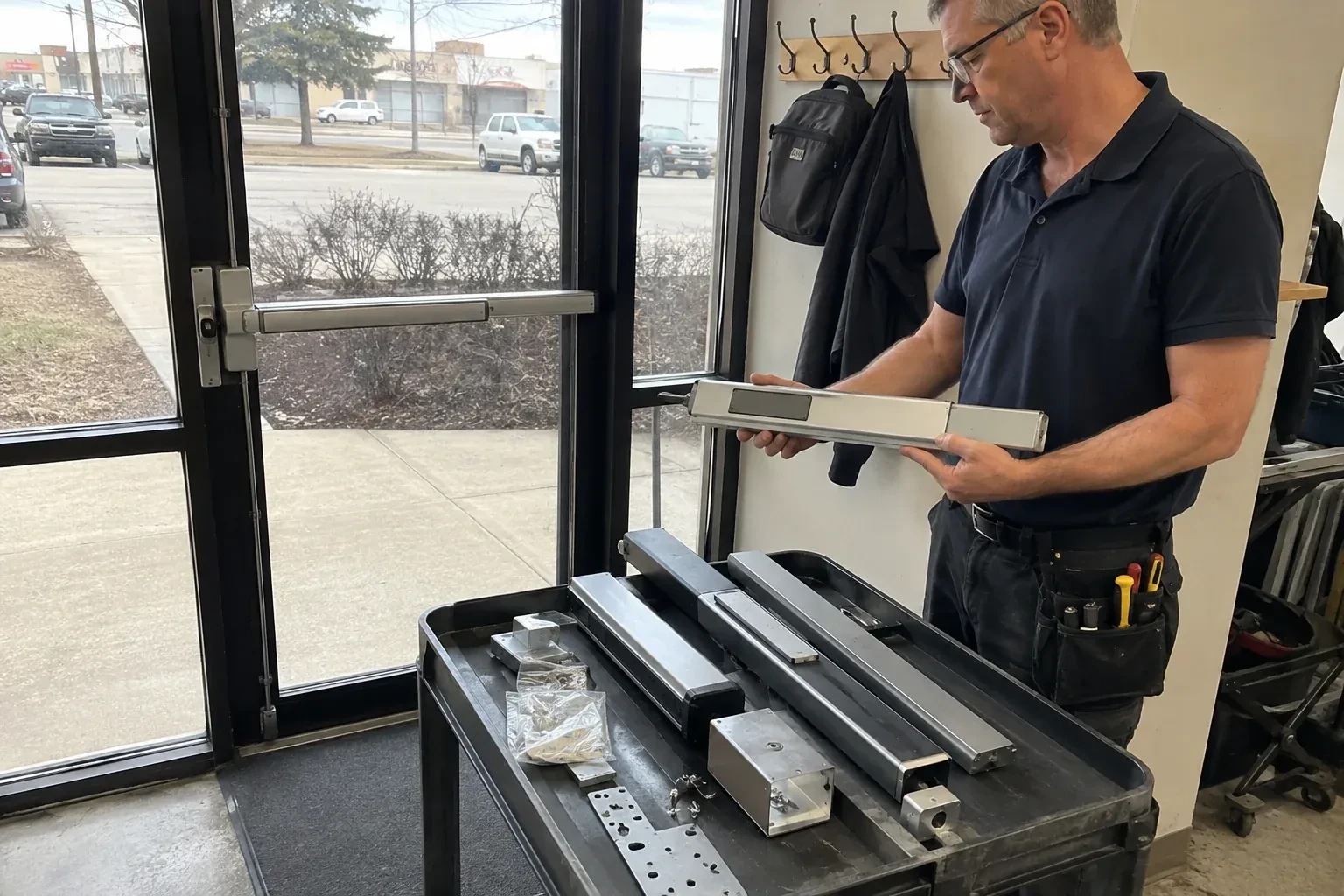
After the fit-out, the gym floor now holds more people than the old office space ever did, and the exit door at the back still has the same turn-lock it had when the room held desks.
A code trigger usually starts the conversation: an occupant load over a threshold, a fire inspector's note, or a new use for a room that used to hold far fewer people. From there the visit works out which openings are affected, what device and trim suit each one, and whether a pair of doors needs a coordinator or a mullion removed. The installation follows a template, and every device is tested for release force and full latch engagement before the visit ends, with a written record of what went on the door for anyone reviewing the space afterward.
Sound familiar?Bridgeport
Panic & Exit Hardware · Bridgeport
Scene 1
The assessment also looks at who has to operate the door: mounting height, the force needed to release the touchpad or crossbar, and whether the outside trim's lever or pull suits someone with limited grip or reach. A door that meets a code minimum can still be awkward for the people who use it every day, so this check asks not only what is required but what will work well for the staff and visitors who pass through the opening.
Scene 2
Once mounted, every device is cycled by hand repeatedly, checking that the touchpad or crossbar releases the latch under a light, even push and that the door swings clear of its frame and any threshold without binding. The strike is checked from both sides to confirm the latch seats fully when the door is pushed closed, not only when it is guided into place by hand. Any adjustment the testing reveals is made on the spot, before the device is called finished.
Scene 3
What the space has afterward is straightforward: anyone inside can leave through that door with a single push on the crossbar or touchpad, no key, no second step, no need to remember which way a lock turns. Staff can be shown the motion once and it stays intuitive, because that is exactly what the hardware is built to do. Outside, entry still works the way it was set up to, through the trim chosen for that door, entirely separate from the exit function inside.
What shapes the quoteHeritage Park Locksmith Specialists
FeesSame any hour
It comes down to occupancy and occupant load rather than preference. Rooms used for assembly, such as banquet halls, places of worship or gyms, and doors serving a stairway in a busier building, are where this hardware becomes the standard choice instead of a keyed lock on the exit side. A fire inspector or building official is the practical way to confirm whether a specific room has crossed that line.
Yes. The releasing device only governs the inside of the door; the outside gets its own trim, a pull, a lever with a cylinder, or a keyed cylinder alone, chosen for how that door is entered. Locking or unlocking that outside trim has no effect on the inside crossbar, which always releases the latch under a push, so entry security and exit function are handled as two separate questions.
Hardware standards set a maximum, not a target: an exit device is built to release the latch under a firm push, no more than about 15 pounds of force applied at the touchpad or crossbar, roughly the pressure of a light shove rather than a heave. That ceiling covers people who cannot lean hard into a door, so the swing stays open to anyone moving toward it under pressure.
WaterlooOntario
Panic & Exit Hardware · Kitchener, Heritage Park, Rosemount, Stanley Park
Every square is one home in a hundred.
On-site assessment
After the fit-out, the gym floor now holds more people than the old office space ever did, and the exit door at the back still has the same turn-lock it had when the room held desks.
(226) 806-0416, open 24/7.
On-site assessment preferred · (226) 806-0416, open 24/7